 how-to
Best Ways to Display Original Art in Your Home
Table of Contents
- Gallery Wall Layout Ideas That Actually Work
- How to Display Original Art Without a Single Nail
- Art Hanging Height Standards: The Rules Worth Knowing
- Best Lighting for Art Display: Protecting and Presenting Your Pieces
- Creative Framing Techniques to Display Original Art
- Conservation and Preservation: Keeping Original Art Safe Long-Term
- Finishing Touches: Tabletop Accents and Curated Shelf Styling
- Frequently Asked Questions
Last Updated: August 12, 2026
Gallery Wall Layout Ideas That Actually Work
The single biggest mistake people make when displaying original art is treating each piece as an isolated decision. A gallery wall works because it creates a conversation between pieces, not a collection of strangers sharing a wall.
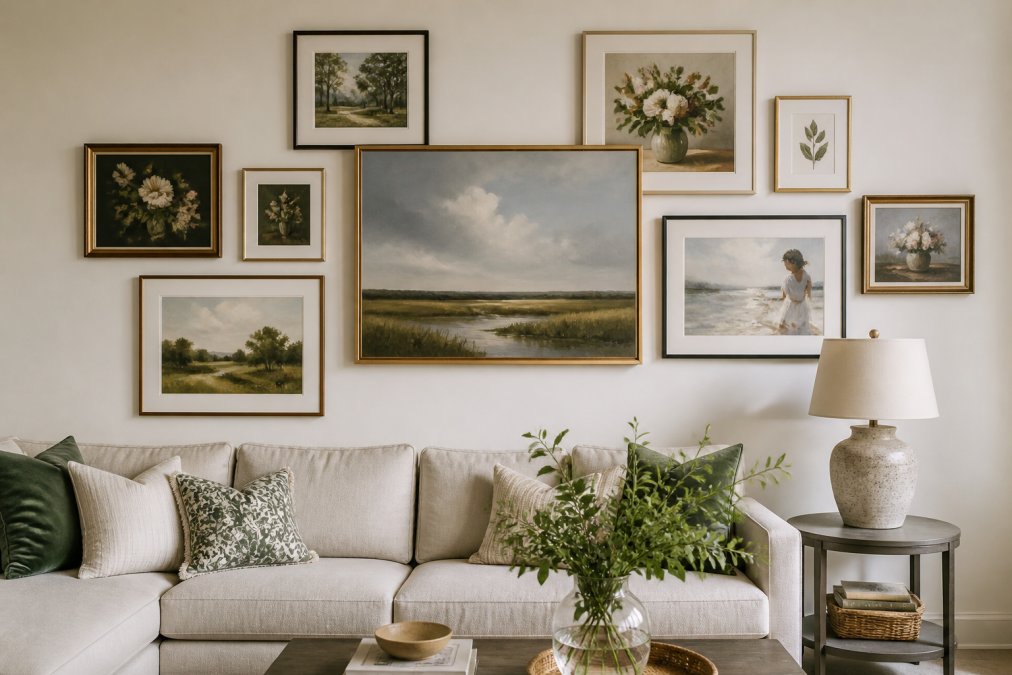
Symmetrical vs. Asymmetrical Arrangements
Symmetrical arrangements use mirrored layouts where pieces of equal size flank a central focal point. They read as formal and grounded, well-suited to dining rooms and entryways.
Asymmetrical arrangements distribute visual weight without mirroring, mixing canvas sizes, orientations, and frame styles. They feel dynamic and personal, dominating living rooms and creative spaces.
For asymmetrical layouts, lay everything out on the floor first. Photograph the arrangement from above, then compare it against your wall dimensions before committing. Adjust spacing so pieces sit roughly 2 to 3 inches apart. Anchor the layout with your largest or most visually complex piece, then build outward, alternating between heavier and lighter visual weights.
Staircase Galleries and Vertical Space
Staircase galleries are one of the most underused opportunities in residential interiors. The ascending wall gives you a natural diagonal line to work with, allowing pieces to hang in a staggered sequence that follows the stair pitch.
Maintain consistent spacing between the bottom edges of frames as you move up the staircase rather than aligning tops or centers. This creates visual rhythm even when frame sizes vary. A display ledge installed along the stair wall lets you prop pieces without committing to fixed hanging points.
Vertical space above doorways and windows is similarly overlooked. A single fine art print positioned above a doorframe draws the eye upward and makes ceilings feel taller.
How to Display Original Art Without a Single Nail
Nail-free display is no longer a compromise. Today's systems are genuinely gallery-quality, making them ideal for renters or anyone who changes their collection regularly.
Picture Rail and Track Systems
Picture rail systems run horizontally near the ceiling and allow artwork to hang from cables or rods that hook over the rail. Pieces can be slid left or right and swapped in seconds without wall damage.
According to Walker Display's guide to picture hanging systems, track-based systems suit everything from lightweight prints to heavier original canvases, provided the rail is properly anchored to wall studs or a structural header. For renters, some systems mount to the ceiling rather than the wall, avoiding any wall damage entirely. Providers like AS Hanging Display Systems offer modular kits that work across brick, drywall, and plaster.
Propping, Easels, and Display Ledges
Propping art is the most flexible display method. A painting leaned against a wall on a console table or display ledge requires zero hardware and can be rearranged in seconds.
Easels work particularly well for a single statement piece. A wooden or metal easel in a living room corner turns one strong original painting into a sculptural moment. Display ledges are the best middle ground between propping and hanging, holding multiple pieces at once while allowing layering and depth.
Art Hanging Height Standards: The Rules Worth Knowing
The standard for art hanging height is 57 to 60 inches from the floor to the center of the artwork. This corresponds roughly to average eye level and is the benchmark used by most professional galleries.
Measure from the floor up to 57 inches, mark that point, then calculate how far above that mark your hanging hardware needs to be based on the artwork's dimensions. Art hanging height standards shift in specific contexts:
| Context | Recommended Center Height | Notes |
|---|---|---|
| Standard room (seated and standing) | 57-60 inches from floor | Gallery standard, works in most rooms |
| Primarily seated space (dining room) | 54-56 inches from floor | Lower eye level when seated |
| Staircase gallery | Follow stair pitch angle | Align bottom edges for visual rhythm |
| Above furniture | 6-8 inches above top of piece | Sofa, console table, headboard |
| Children's rooms | 48-52 inches from floor | Scaled to child's eye level |
When hanging art above furniture, the relationship between the art and the furniture matters more than the absolute height from the floor. Keep the gap between the top of the sofa and the bottom of the frame between 6 and 8 inches.
Best Lighting for Art Display: Protecting and Presenting Your Pieces
Lighting does two things simultaneously when you display original art: it presents the work and either protects or damages it.
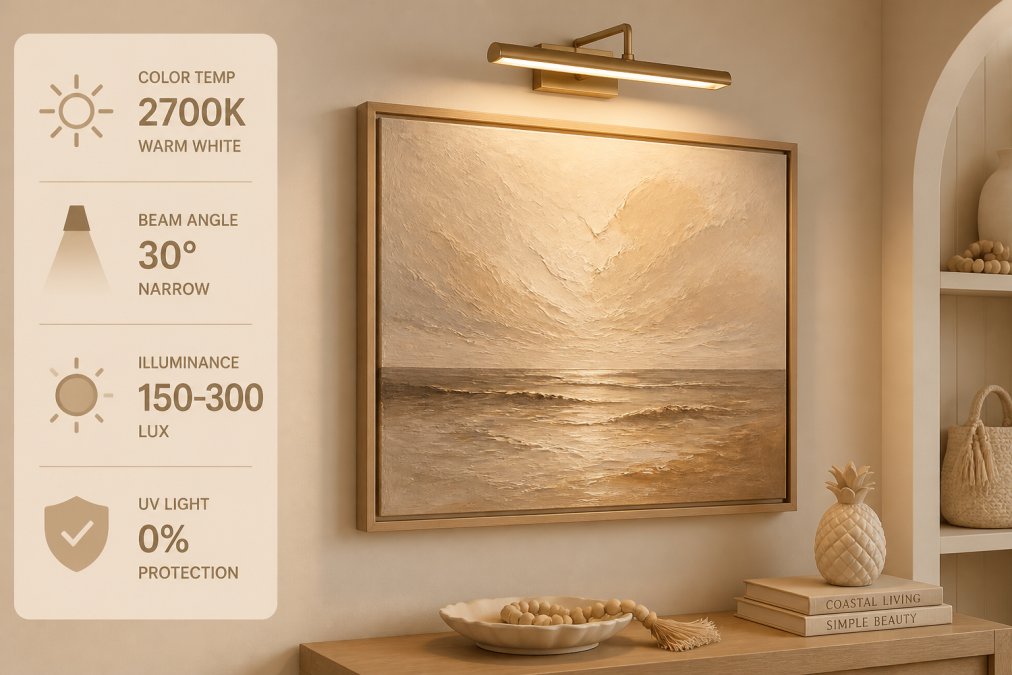
The best lighting for art display uses dedicated picture lights or adjustable track lighting aimed at approximately 30 degrees from vertical. This angle minimizes glare while bringing out texture and color depth.
According to the Smithsonian Institution's guidelines on light damage to art, UV radiation and heat are primary causes of fading and deterioration. Use LED bulbs rated for art display, which produce minimal UV output and run cooler than incandescent sources. Avoid hanging original works directly opposite south-facing windows. If natural light is unavoidable, UV-filtering glazing in the frame provides meaningful protection.
Color temperature matters for presentation. Warm white LEDs in the 2700K to 3000K range flatter oil paintings and warm-toned works. Cooler light in the 4000K range can make watercolors feel crisper. Choose based on the artwork's palette.
Creative Framing Techniques to Display Original Art
The frame is not decoration. It is the first editorial decision you make about how a piece communicates with its environment.
Floating Frames, Shadow Boxes, and Matting
A floating frame suspends the artwork within the frame with a visible gap between the canvas edge and the frame molding. This works especially well for textured originals and stretched canvases, reading as contemporary and letting the artwork breathe.
Shadow boxes create depth by recessing the artwork behind a frame with significant depth. They suit mixed-media works and dimensional pieces that benefit from protection and visual separation from the wall.
Matting creates a border of archival board between the artwork and the glazing. Beyond aesthetics, proper matting prevents the artwork surface from touching the glass, which can cause condensation damage. For works on paper, archival matting is essential for long-term preservation.
Custom framing services like Framebridge and Simply Framed offer professional guidance on which approach suits different types of original work.
Mixing and Matching Art Styles in One Space
The fear of mixing art styles is largely unfounded. A coastal watercolor next to a geometric abstract can work beautifully, provided the framing creates visual continuity. Consistent frame finishes, shared matting color, or unified frame width creates enough cohesion to let stylistic contrast read as intentional curation.
What disrupts a mixed-style display is inconsistent scale. Group smaller works together or mat them significantly to bring them up to visual weight.
Conservation and Preservation: Keeping Original Art Safe Long-Term
Original artwork is an investment, and its condition depends almost entirely on how it is stored and displayed. The four primary threats to original art in a home environment are light exposure, humidity fluctuation, temperature extremes, and physical contact.
Humidity and temperature: Original works on canvas and paper are sensitive to fluctuating humidity. The American Institute for Conservation's guidance on caring for art recommends maintaining relative humidity between 45% and 55% and avoiding display on exterior walls, which are prone to temperature swings and condensation.
Archival materials matter throughout the display chain. Acid-free backing boards, archival matting, and UV-filtering glazing are baseline protection for original works. Non-archival materials off-gas acids over time that yellow paper and degrade pigment.
Physical handling: Always handle original works with clean cotton gloves or by the frame edges only. Oils from skin contact cause long-term deterioration to both artwork surface and frame finishes.
Damage-free hanging systems protect both the wall and the artwork by reducing the risk of pieces being dropped or jarred during hardware changes.
Finishing Touches: Tabletop Accents and Curated Shelf Styling
A framed original on a shelf or console table rarely stands alone effectively. The objects around it determine whether the display reads as intentional or incidental.
Vary height, material, and scale. A painting propped on a console table works best when flanked by objects at different heights, a tall ceramic vessel on one side, a lower sculptural element or stack of books on the other. This creates a visual triangle that grounds the artwork without competing with it.
Palms 30A carries curated tabletop accents that work alongside original art. The Artichoke Flower Holder is a handmade ceramic piece that pairs naturally with framed originals on a shelf or mantel, adding organic texture without visual noise. The LSU Tiger Trinket Tray and Big Al Trinket Tray bring personality to desk or tabletop displays, particularly in spaces where the art leans personal rather than formal.


The goal is to make the art the focal point while surrounding objects provide context. Avoid overcrowding. Three well-chosen objects outperform seven mediocre ones.
A quick-reference checklist for tabletop display:
- Anchor with the artwork or largest piece first
- Add one tall element (vase, candleholder, sculptural object)
- Add one low element (tray, small object, stacked books)
- Leave negative space; resist filling every inch
- Check the arrangement from seated height, not just standing
Interior styling at this scale is where a well-chosen accessory earns its place. The objects you choose to surround original art say as much about your curation sensibility as the art itself.
Frequently Asked Questions
What is the 57-inch rule for hanging art?
The 57-inch rule means the center of any artwork should sit 57 inches from the floor, roughly average eye level for most adults. This is the standard used in professional galleries and by most interior designers. To find your hanging point, measure the artwork's height, divide by two, then subtract the distance from the top of the frame to the hanging wire or D-ring. Add that number to 57 to get where your nail or hook should go.
How do you display original art without damaging the walls?
Picture rail systems, adhesive strips rated for your artwork's weight, and French cleats are the most reliable damage-free options. Track-based hanging systems allow you to display original art and rearrange pieces without any new holes. For lighter works, propping art on a display ledge, console table, or mantel shelf is completely nail-free. These approaches are especially practical in rentals or any space where wall repairs are not an option.
What is the best lighting for displaying original paintings?
LED picture lights or adjustable track lighting with a color temperature between 2700K and 3000K bring out warm tones in original artwork without washing out detail. Avoid placing paintings in direct sunlight or under fluorescent lighting, both cause fading over time. For fine art prints and original works on paper, UV-filtering glass or acrylic in the frame adds a critical layer of protection. Aim for lighting that illuminates the full surface evenly without creating harsh glare or hot spots.
How do you create a cohesive gallery wall with original pieces?
Start by choosing a unifying element, consistent framing, a shared color palette, or a common subject matter. Lay all pieces on the floor first and photograph the arrangement before committing to the wall. Keep spacing between frames consistent, typically 2 to 3 inches, and anchor the composition around one statement piece near the center. Mixing frame finishes works well when the artwork itself ties the grouping together through color or style.
Displaying original art well is genuinely one of the most personal things you can do with a home, and the technical details matter more than most people realize. Palms 30A offers original art pieces and handcrafted home accessories specifically chosen to help you build displays that feel considered rather than incidental. Browse the collection and find the pieces that belong in your space.
This article was written using GrandRanker