 comparison
Artisanal Clothing vs Fast Fashion: Why Choose Handmade
Table of Contents
- Artisanal Clothing vs Fast Fashion: What Actually Separates Them
- Sustainable Fashion vs Fast Fashion: The Environmental and Labor Gap
- Handmade Clothing Benefits That Show Up in Daily Wear
- Cost Per Wear: The Math That Changes the Price Conversation
- How to Identify Handmade Clothing Before You Spend
- The Trade-Offs of Artisanal Clothing Nobody Mentions
- Building a Smaller, Better Wardrobe: Care, Repair, and Resale
- Frequently Asked Questions
Last Updated: October 20, 2026
Artisanal Clothing vs Fast Fashion: What Actually Separates Them
Artisanal clothing is garments made in small batches by skilled makers who control the materials, the stitching, and the finish, rather than clothing produced at industrial scale to chase a trend. The difference shows up in how long a piece lasts, who made it, and what it truly costs per wear. At Palms 30A, we curate handcrafted pieces. Below, we break down why choose artisanal clothing over fast fashion, including the trade-offs nobody mentions.
Fast Fashion's Speed Problem
Fast fashion compresses the design-to-shelf cycle into weeks. New drops land constantly, which keeps prices low and turnover high. That model depends on volume: the more units move, the cheaper each one gets. The consequence is a garment designed to survive a season, not a decade. Seams are serged fast, buttons are glued or lightly tacked, and fabric is chosen for cost rather than hand-feel. Speed is the product. Durability is not.
What Artisanal Clothing Really Means
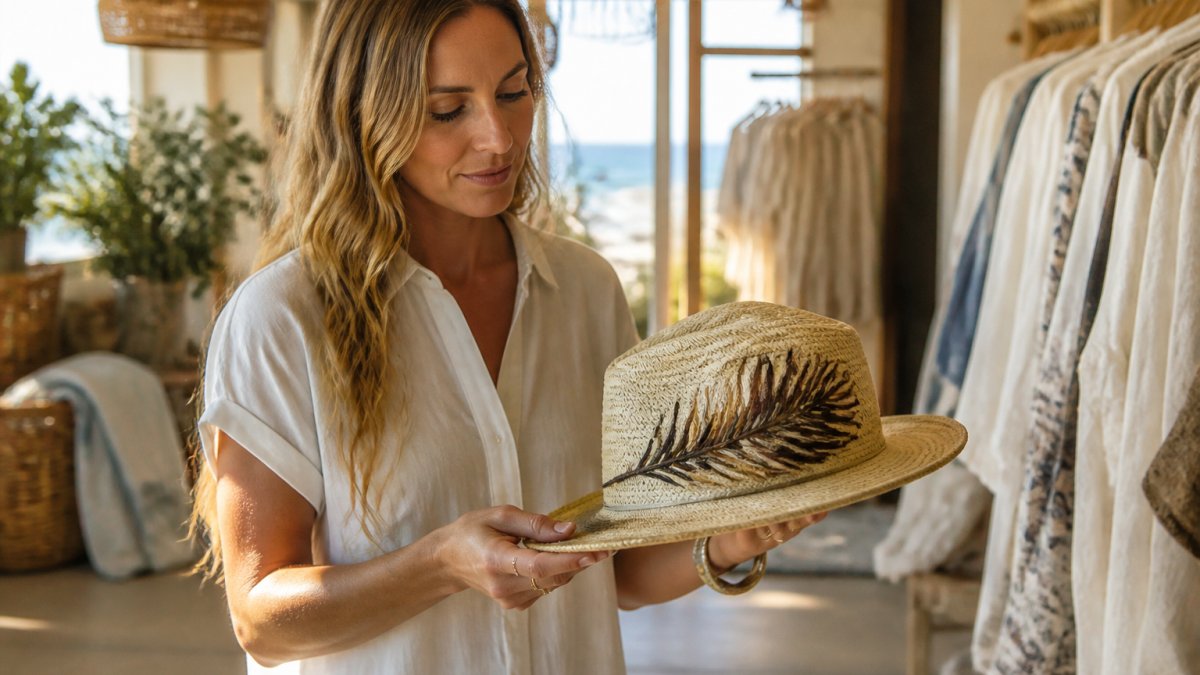
Artisanal clothing is fashion produced by individual makers or small workshops using hand techniques, limited runs, and materials chosen for how they age. Hand-stitched details, hand-painted finishes, and one-of-a-kind variations are the signature. Our Pluma Embroidered Hat is a clear example: skilled female Mexican artisans hand-stitch feather designs onto a handwoven fedora body, so no two hats measure or look exactly alike. That variation is the point, not a defect.

Sustainable Fashion vs Fast Fashion: The Environmental and Labor Gap
Sustainable fashion and fast fashion diverge on two fronts: resource use and who bears the cost. Mass production consumes large volumes of water and energy and leans on synthetic fabrics that shed microfibers and resist breakdown. Small-batch production uses less volume and often favors natural fibers and organic materials. The labor picture matters just as much. Fast fashion's low prices depend on squeezing wages somewhere in the supply chain; artisanal production keeps the maker visible and typically pays for skilled work. The FTC guidance on green claims is worth reading before you trust any sustainability label, because vague terms like "eco" carry no legal weight.
The Environmental Mechanisms, Concretely
Fast fashion's footprint is not one problem but several stacked on top of each other. Fiber production is the first: conventional cotton is a thirsty crop, and polyester is petroleum-derived and does not biodegrade on any useful timescale. Dyeing and finishing are the second: textile wet processing is water- and chemical-intensive, and untreated effluent is a well-documented problem in high-volume production regions. The third is garment lifespan.
Artisanal production does not make these problems vanish, and honest sellers should not claim it does. A hand-dyed piece still uses dye; a handwoven natural-fiber garment still consumed water and land to produce. What small-batch production changes is scale and intent: fewer units made, materials chosen for how they age rather than how cheaply they can be sourced, and construction that assumes the garment will be worn for years. The environmental case for artisanal clothing is strongest when it is framed as waste reduction and longevity, not as a claim of zero impact.
The Labor Picture
Fast fashion's low prices depend on squeezing wages somewhere in the supply chain, and the pressure often lands on the least visible workers: sewers paid by the piece, home-based workers, and subcontracted facilities several tiers removed from the brand. Artisanal production keeps the maker visible. When a workshop is named and a technique is described, the person doing the skilled work is not anonymous, and the price reflects skilled labor rather than hiding it.
The Angle Most Comparisons Skip: Artisan Livelihoods and Cultural Preservation
Most fast-fashion-versus-sustainable comparisons stop at emissions and wages. The artisanal case adds something the others miss: craft knowledge is a living inheritance, and it disappears when no one can afford to keep practicing it. Hand-embroidery, hand-weaving, hand-stitching, and hand-painting are learned over years and passed between generations. When those techniques lose their market, the skills go with them, and they are difficult to rebuild once the last practitioners stop teaching.
Buying artisanal clothing is therefore a purchasing decision with a cultural dimension. It supports small workshops and the local economies around them, and it keeps specific techniques in active use rather than preserved only in museums. That is a distinct argument from the environmental one, and it is the reason a hand-embroidered hat or a hand-stitched leather belt can matter beyond its cost per wear. The EPA guidance on textile waste covers the waste side of the equation; the livelihoods side is the part a label cannot capture.

Handmade Clothing Benefits That Show Up in Daily Wear
Handmade clothing benefits are practical, not abstract. A hand-finished seam sits flatter and holds longer. Natural fibers breathe better in heat. Small-batch construction means someone inspected the piece before it shipped. The everyday payoff is a garment that feels better on the tenth wear than the first.
Consider the Pampeano hand-stitched leather polo belt. That is the difference between an accessory you replace and one you keep.
Cost Per Wear: The Math That Changes the Price Conversation
Cost per wear is the purchase price divided by the number of times you actually wear the item. A $149 hand-embroidered hat worn 60 times costs about $2.48 per wear.
| Item | Price | Wears | Cost Per Wear |
|---|---|---|---|
| Mass-market trend piece | $40 | 8 | $5.00 |
| Handcrafted leather belt | $125 | 150 | $0.83 |
| Hand-embroidered fedora | $149 | 60 | $2.48 |
| Hand-painted ceramic charm | $10 | 40 | $0.25 |
Run this math before any purchase over $50. It reframes affordability around long-term value rather than the sticker.
How to Identify Handmade Clothing Before You Spend
How to identify handmade clothing comes down to evidence. Look for visible stitch irregularity, maker attribution, and construction details a machine would not bother with. Then verify the claim.
- Ask who made the piece and where
- Check whether the maker or workshop is named
- Look for hand-finished seams, hand-wrapped details, or hand-painted elements
- Confirm fiber content on the label, not just the marketing copy
- Ask how the seller verifies artisan sourcing
- Read the return policy before ordering online
A seller who can name the workshop and describe the technique is a better bet than one who uses "artisanal" as a mood word. Our Handcrafted Scarf Charm Necklace lists its hand-wrapped details and lead & nickel compliance.

Verify the Claim, Not the Vibe
Most shoppers stop at "it looks handmade." The stronger move is to check four things in order: materials, labor, provenance, and certifications.
Materials. Read the fiber content label, not the product description. A garment described as "natural" but labeled with a high synthetic percentage is telling you something. Ask whether the fiber is organic, recycled, or conventional, and whether the dye process is disclosed.
Labor. Ask who made the piece and whether the workshop is named. A named maker or workshop is a stronger signal than a generic "ethically made" badge.
Provenance. Where was it made, and by whom? A specific region and a specific technique are more credible than a country name alone. Hand-embroidery from a named workshop is verifiable; "imported" is not.
Certifications. Third-party certifications are not perfect, but they are checkable. The FTC guidance on green claims explains why vague terms like "eco-friendly" carry no legal weight and why specificity is the thing to demand.
Handmade Does Not Automatically Mean Ethical or Sustainable
This is the part most buying guides leave out. A hand-made garment can still be made in unsafe conditions, paid below a living wage, or dyed with harsh chemicals. "Handmade" describes a production method, not a moral guarantee. The same is true of "artisanal": it is unregulated, and a mass-produced item can carry the label.
So treat handmade as a starting point for questions, not an answer. The combination that matters is a named maker, a disclosed material, a described technique, and a seller willing to answer follow-up questions. If any of those is missing, the piece may still be worth buying, but buy it for how it looks and wears, not for a claim it has not earned.
The Trade-Offs of Artisanal Clothing Nobody Mentions
Artisanal clothing has real limitations, and honest sellers should say so. Prices are higher because skilled labor is not cheap. Sizing varies because pieces are made by hand, so you may need to check measurements rather than assume your usual size. Restocks are slow or impossible on one-of-a-kind items. Selection is narrower than a fast-fashion site. If you need a specific color in a specific size by Friday, artisanal is the wrong channel. If you want a piece you will still wear in five years, it is the right one.
Building a Smaller, Better Wardrobe: Care, Repair, and Resale
A smaller wardrobe built on fewer, better pieces changes how you shop. Care for natural fibers with cooler washes and air drying. Repair loose stitching early rather than replacing the garment. Resell or gift pieces you have outgrown; handcrafted goods hold resale value far better than trend items. This is where the environmental impact argument becomes personal: waste reduction starts with buying less and keeping it longer. The EPA guidance on textile waste outlines why keeping garments in use matters.
Frequently Asked Questions
What is the difference between artisanal clothing and fast fashion?
Artisanal clothing is made in small batches by skilled makers, often by hand or with minimal automation, using materials chosen for durability. Fast fashion is mass-produced on tight cycles to chase current trends, usually from synthetic fabrics. The practical difference shows up in construction, fit consistency, and how long a garment holds up. Artisanal pieces often carry slight variations because a person made them, while fast fashion aims for identical units at the lowest cost.
Is artisanal clothing actually more sustainable than fast fashion?
Usually, but not automatically. Small-batch production tends to reduce overproduction and textile waste, and natural fibers like cotton, linen, and leather can last longer than cheap synthetics. That said, sustainability depends on the maker's sourcing, dyeing, and shipping practices. Ask where materials come from and how the piece was finished. A handmade garment made from low-grade materials can still wear out fast, so treat craftsmanship and material quality as separate checks.
Why does artisanal clothing cost more than fast fashion?
You are paying for time. A hand-stitched belt or handwoven hat can take hours of skilled labor that mass production replaces with machines and volume. Fair wages, smaller material orders, and limited runs also raise the unit cost. The trade-off is durability and uniqueness. A $125 hand-stitched leather belt worn weekly for years often costs less per wear than three $30 belts that crack and get replaced. Price per wear matters more than the sticker price.
How can you tell if clothing is genuinely handmade?
Look for small inconsistencies that machines do not produce: slightly uneven stitching, hand-finished seams, and minor variations between units. Check whether the maker or artisan group is named, and ask for details about where and how the piece was made. Genuine handmade items often come with care instructions specific to the materials. If a listing claims handmade but shows identical factory-perfect units in every color with no maker information, treat the claim with caution.
Fast fashion asks you to buy often and replace quickly. Artisanal clothing asks you to buy once and keep it. That trade-off is the whole argument, and it is why we stock handcrafted hats, belts, and jewelry at Palms 30A: pieces with a named maker, a real technique behind them, and a cost per wear that keeps falling the longer you wear them. Browse our curated collection and find the piece you will still reach for next year.